Deutsch
 English

The IEVB is equipped with state-of-the-art testing and measurement equipment for material data analysis and the investigation of material and energy transformations in materials. A particular focus is placed on investigating structure-property-process relationships. The laboratory infrastructure is divided into three main areas of focus:
- Molecular characterization and fractionation of polymers, as well as establishing the relationship between thermal, calorific, and rheological properties and the molecular polymer structure under various process conditions. A dedicated large-scale research facility, the “Integrated Polymer Fractionation and Analysis Platform (i-PFAP),” is available for this purpose. This area of focus is particularly important for the development of new, recycling-friendly molecular composites and for the development of new concepts for physical plastic recycling.
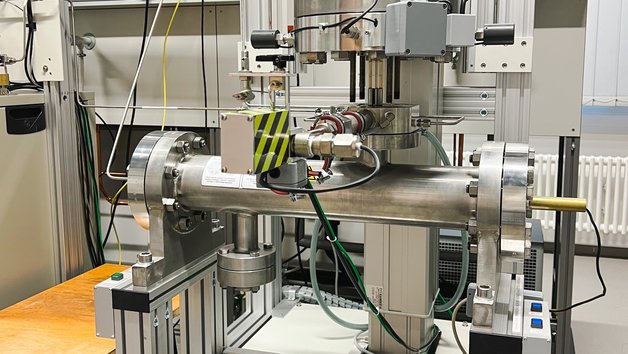
- Investigation of material and energy transformations under extreme conditions (high pressure and high temperature). In addition to gas-polymer systems, energy conversion processes are also investigated in metallic and mineral composites at high temperatures (up to 2000 °C) and high pressures (up to 1000 bar). The material data obtained in this process are used in model development and simulation for calibration and validation and are significant, among other things, in the field of “Engineering of Artificial Minerals” and in the development of new sustainable thermal energy storage systems. This laboratory also conducts fuel characterization studies, particularly of decarbonized fuels and alternative fuels.
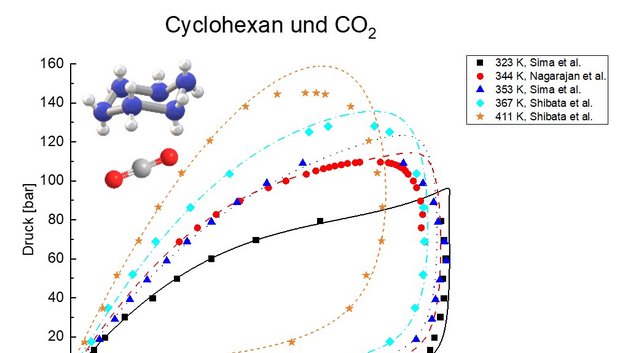
Measurement of phase equilibria (LLE, VLE, SLE) of low-molecular-weight substances and polymer-solvent systems, including corresponding composition analysis via GC and MS up to 250 °C.
Integrated Polymer Fractionation and Analysis Platform (i-PFAP)
DFG Large-Scale Facility
Principal Investigator: M. Fischlschweiger
Collaborating Research Groups at Clausthal University of Technology: Valerian Hirschberg, Sabine Beuermann (Department of Chemical Engineering), Jens Bremer, Thomas Turek (Institute of Chemical Process Engineering), Leif Steuernagel (Institute of Polymer Materials and Plastics Technology)
Polymers and polymer matrix composites are key materials for numerous current and future applications. Their potential for innovative manufacturing methods and new product designs is enormous. At the same time, they are complex multicomponent systems whose macroscopic properties are directly determined by the molecular structure of the polymers. To understand these structure-property relationships and leverage them effectively for material development, precise experimental data and predictive models are essential.
The i-PFAP enables a comprehensive experimental investigation of the relationship between molecular structure and the thermodynamic and rheological behavior of polymers. This information can be directly applied to the development of holistic models that allow for the qualitative and quantitative prediction of relevant material properties.
With its integrated combination of cross-fractionation chromatography (CFC), pilot-scale preparative fractionation (PrepC20), shear rheology and tensile rheology, as well as high-temperature and high-pressure calorimetry, the i-PFAP offers a unique platform for addressing fundamental and application-oriented questions in polymer characterization and polymer thermodynamics. In this way, it supports the development of new materials, improves recycling strategies, and makes an important contribution to a sustainable circular economy.
If you are interested in analyses, please contact Thore Pohl directly; for coordination of facility use, please contact Ms. Anna-Kai Keller.