
 Deutsch
 English
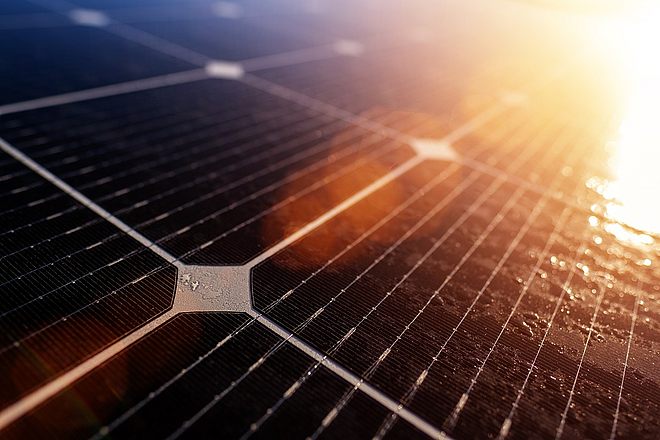
Photovoltaic (PV) technology will play a prominent role in a decarbonized and decentralized energy supply—both globally and regionally in Lower Saxony. To date, the PV market has been dominated by silicon (Si) technology, which features only a single absorber and is approaching its practical efficiency limit. The next-generation photovoltaic technologies currently under development combine two or more absorber materials in tandem or “multijunction” solar cells, thereby making better use of the solar spectrum by reducing thermalization losses. This opens up the possibility of increasing efficiency by 30%rel to 50%rel compared to the current state of “single-absorber” technology. Only in the last few years have two of the three prerequisites for such tandem technology appeared to be met: On the one hand, the hoped-for high efficiency potential of novel absorber materials with suitable bandgaps—particularly metal halide perovskites (Pk)—has been demonstrated at the laboratory level; on the other hand, the non-epitaxial fabrication process can be made cost-effective. Intensive research efforts are underway worldwide in this area, supported in Germany partly by the EU, partly by the federal government, and partly by the states of Berlin, Baden-Württemberg, and North Rhine-Westphalia at their respective locations. The third key prerequisite—sufficient long-term stability—is the subject of current research. In our subproject, we are investigating the potential environmental impacts in comparison to conventional technologies and the energy payback time as a parameter for the ecological and economic sustainability of the new generation of PV.


Contact person: Jan Schlecht, M.Sc. (Environmental Science)
Research associate
Contact: Jan Schlecht
Phone: +49 5323 72‑6280
E‑mail: jan.schlecht@tu-clausthal.de
Address
Leibnizstraße 23
38678 Clausthal‑Zellerfeld
Germany